
How can organizations ensure that people, systems, and AI not only use the same words, but actually mean the same thing? This was one of the central questions at the 16th International Conference on Formal Ontology in Information Systems (FOIS), held from September 21–25, 2026, in Vitória, Brazil. Y.digital was there to contribute to the discussion and demonstrate how Applied Ontology, Semantic Web technologies, and AI can work together to improve information management and support digital transformation.
Why the same words don't always mean the same thing
Organizations collect and process enormous amounts of data. This information comes from different systems, departments, and sources. At first glance, connecting all this data may seem straightforward. A person is a person, an organization is an organization, and an event is an event. But in practice, things are rarely that simple.
Take the concept of a person. Does it refer to a human being, someone who is legally capable of acting independently, or a legal entity such as a company? Although we may use the same word for all these concepts, they represent fundamentally different things. They have different properties and play different roles in business processes and information systems.
When these distinctions are not made explicit, misunderstandings can arise. Systems may combine information that looks similar from a technical perspective but actually represents something quite different. This is more than a data quality issue. It can affect business processes, information exchange between organizations, and ultimately the reliability of AI applications.
Formal ontology: understand first, digitize second
This is where Formal Ontology comes in. At its core, it is about establishing a clear understanding of what things are, what properties they have, and how they relate to one another. The goal is not simply to create as many definitions as possible. It is to develop a shared and consistent understanding of the reality an organization needs to represent. Only when we understand what concepts actually mean can we translate them reliably into information models, databases, and software.
This may sound obvious, but many digital projects skip this important step. Data models are created, terminology is defined, and systems are connected without first examining the meaning behind the concepts being used.
The result? Systems that may function perfectly well from a technical perspective but do not always behave as expected in practice. The information is available, but its meaning is not always clear.
By making the right conceptual distinctions from the start, organizations can build a much stronger foundation for their digital solutions. Data becomes easier to combine, information becomes more consistent, and systems can work together more reliably.
Why this matters more than ever in the age of AI
The rise of AI agents and Large Language Models makes clarity of meaning even more important. AI can process enormous amounts of information and identify relationships, but that does not automatically mean it interprets the information correctly.
Simply adding an ontology or glossary to an AI solution is not enough. If the underlying concepts have not been properly defined, AI will inherit that ambiguity. It may produce convincing answers based on assumptions that are fundamentally incorrect. That is why we need to go beyond simply encoding terminology. We need to understand what concepts mean, how they relate to one another, and which rules govern those relationships.
Applied Ontology provides a practical foundation for doing exactly that. It helps organizations make the meaning of their data explicit and translate that knowledge into digital applications.
Consider the representation of events and business processes. What exactly constitutes an event? When does it begin and end? How does it relate to other events? These questions are relevant to a wide range of applications, from processing orders and customer service tickets to analyzing security incidents and cyberattacks. By explicitly modelling the meaning and relationships within information, organizations also give AI applications a much stronger foundation on which to operate.
Y.digital at FOIS 2026: bringing theory into practice
FOIS 2026 brought together researchers and professionals from around the world to exchange knowledge and discuss these challenges. For Y.digital, it was an opportunity not only to contribute to the international conversation but also to demonstrate how these insights can be applied in real-world projects.
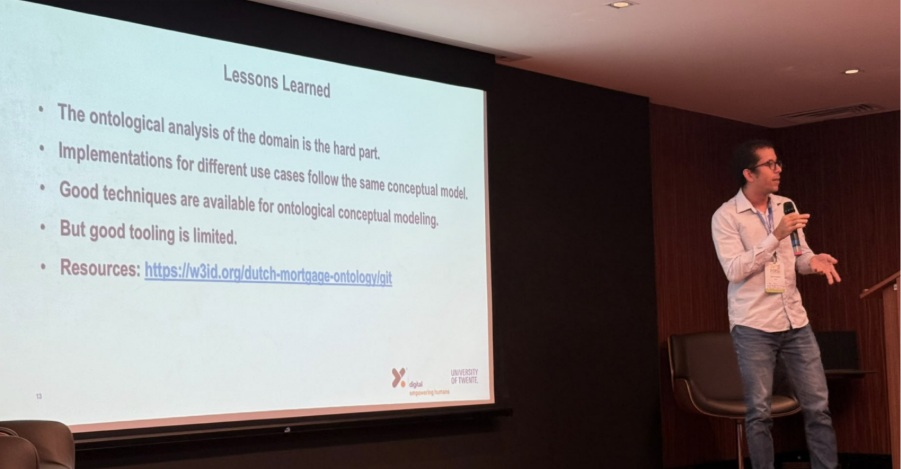
Our colleague Ítalo Oliveira was involved in several parts of the conference. He served as Local Chair of the third edition of the Semantic Shields workshop, which he has co-organized since its first edition with Daniele Francesco Santamaria from the University of Catania, Italy. He also delivered a keynote on the ontological foundations of security and why they matter, as part of a program involving three workshops: FOMI, COMOD, and Semantic Shields. Finally, he presented a practical project carried out by Y.digital for the Royal Dutch Association of Civil-law Notaries (KNB) during the Industrial Project Exhibitions Track.
From mortgage deeds to meaningful data: a real-world example
Together with the KNB, Y.digital explored how information contained in mortgage deeds can be transformed into structured data while preserving its meaning and the relationships between different pieces of information.
The approach combines rigorous ontological analysis, Semantic Web technologies, and AI agents. The result is a way to transform information from mortgage deeds into structured, semantically rich data and bring it together in a knowledge graph.
The real value lies in what organizations can subsequently do with this information. Instead of data being locked away in documents or scattered across separate systems, organizations gain access to a connected information environment in which concepts and relationships are explicitly defined. This makes it easier to retrieve information, connect data, and develop new applications. It also provides AI with a much stronger foundation for interpreting and using information consistently.
The project demonstrates that ontology is far from being a purely theoretical exercise. By combining conceptual rigour with practical technology, organizations can make tangible progress in their digital transformation.
Building a strong foundation for the digital future
Digital transformation is not just about implementing new technologies. It is about ensuring that information is understood, shared, and used in the right way.
Formal and Applied Ontology help organizations establish that foundation. By clarifying concepts, properties, and relationships upfront, they can prevent ambiguity from finding its way into databases, applications, and AI solutions.
At Y.digital, we believe that combining conceptual expertise with technological innovation is what makes the difference. Ontology, Semantic Web technologies, and AI are not isolated solutions. They reinforce one another when built on a shared understanding of information. That is how we help organizations develop digital solutions that work not only today but are also ready for the challenges of tomorrow.
Want to know more?
Y.digital helps organizations in both the public and private sectors turn complex information challenges into reliable digital solutions. With our expertise in Applied Ontology, Semantic Web technologies, and Large Language Models, we build solid semantic foundations for data and AI.
Curious about what this could mean for your organization? Feel free to get in touch.
- Ítalo Oliveira, Senior Information Analyst - italo@y.digital
- Jan Voskuil, Managing Director, Ontologist and Linked Data Advisor - jan@y.digital
